
For several months, a group of children were immersed in riding the school bicycles down one of the hills on our land. They'd strap on their helmets (and if they needed to, ask for support clicking the straps on), walk the bikes to the top of the hill, hop on the bikes and ride down, usually with huge smiles on their faces and thoughtfulness in their eyes.

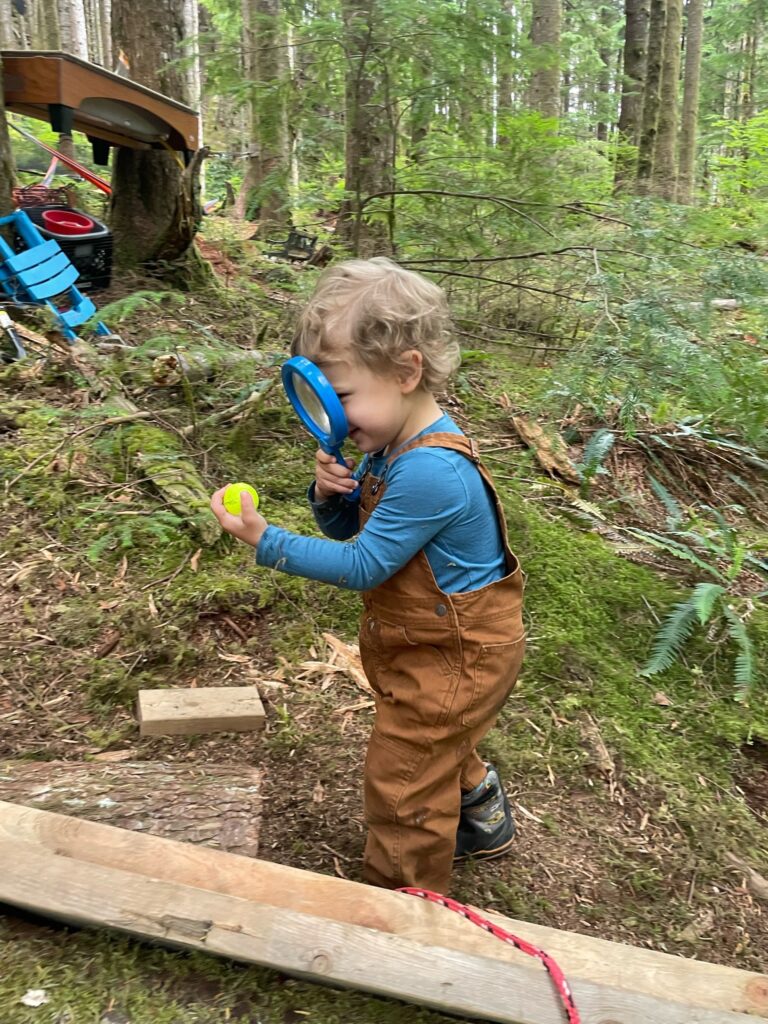
Following the constructivist approach, we provided opportunities to dive deeper into their learning. We provided wooden ramps of different sizes and angles for children who wanted to navigate new terrain – and develop their cognitive skills through problem-solving and spatial reasoning. We provided orange cones and wooden blocks for children who wanted to work on their own or together to design obstacle courses – and develop their socio-emotional skills and learn about cause and effect.
We provided wooden ramps of different sizes and angles for children who wanted to navigate new terrain – and develop their cognitive skills through problem-solving and spatial reasoning.
Through following their lead, we were able to meet them in their interests and then scaffold each child's learning and development in ways that aligned with each individual child (even while they were engaged in the group).

As the colder months arrived -- and with the cold, snow!! -- this interest naturally shifted. One of the many exciting reasons we pair the constructivist approach with outdoor and nature-based learning is that we have the opportunity to see what fades as we shift into a new season, and what resurfaces when we return to the season in a new year.